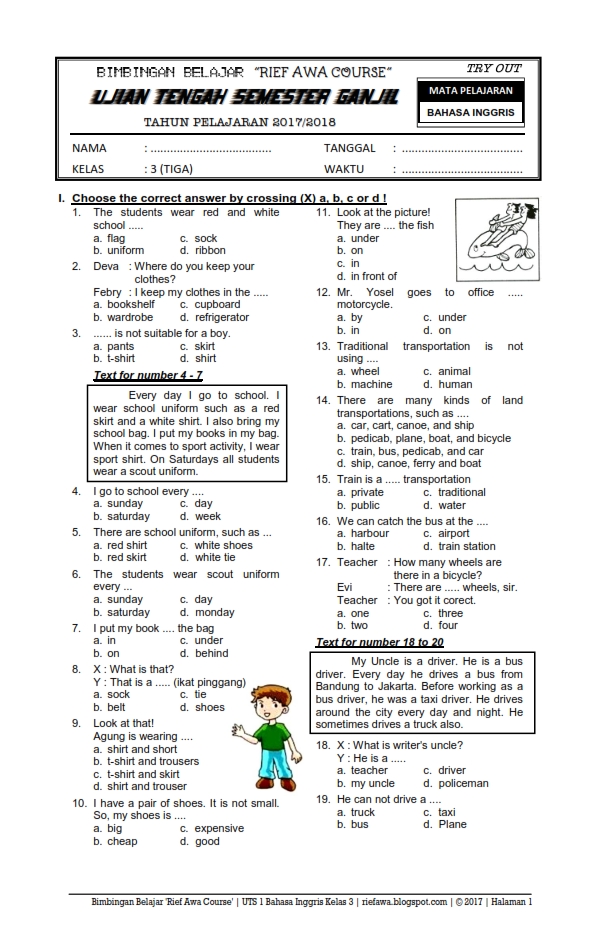
I. Introduction: Understanding the Mid-Semester Exam
The mid-semester examination (UTS) for English Language in Grade 1, Semester 2, marks a significant checkpoint in a student’s academic journey. It assesses the knowledge and skills acquired throughout the first half of the semester, focusing on foundational concepts and building blocks for future learning. This article provides a comprehensive overview of the typical content covered in such an exam, offering valuable insights into the types of questions students can expect and strategies for effective preparation. The scope of the exam generally encompasses vocabulary, basic sentence structures, simple tenses, and elementary comprehension skills. Success hinges not only on memorization but also on understanding the underlying principles and applying them practically.
II. Key Areas Covered in the UTS
A Grade 1, Semester 2 English UTS typically covers several key areas, ensuring a well-rounded assessment of the student’s progress. These areas often overlap and build upon each other, demonstrating a gradual progression in language acquisition.
A. Vocabulary: This section typically tests recognition and usage of basic vocabulary words introduced throughout the semester. The words are usually related to everyday life, common objects, animals, actions, and simple descriptive adjectives. The assessment methods may include:
- Matching: Matching words to their pictures or definitions.
- Multiple Choice: Selecting the correct word to complete a sentence.
- Fill in the Blanks: Filling in missing words in a sentence or short paragraph.
- Labeling: Labeling pictures with the appropriate words.
The vocabulary tested will likely reflect the textbook and classroom materials used during the semester. Regular review and active engagement with vocabulary exercises will significantly improve performance in this section.
B. Sentence Structure: This section assesses the student’s understanding of basic sentence construction. Students will be expected to identify and construct simple sentences, focusing on subject-verb agreement and correct word order. Typical questions might include:
- Identifying Subjects and Verbs: Identifying the subject and verb in a given sentence.
- Sentence Completion: Completing sentences with appropriate words to form grammatically correct structures.
- Sentence Ordering: Arranging jumbled words to form meaningful sentences.
- Sentence Writing: Constructing simple sentences based on given pictures or prompts.
Understanding the basic structure of a sentence (subject-verb-object) is crucial for success in this section. Practicing sentence construction with different subjects and verbs will greatly enhance a student’s ability to perform well.
C. Simple Tenses: Grade 1 students are usually introduced to the present tense (simple present) and sometimes the past tense (simple past). The UTS will assess their understanding and usage of these tenses. Questions may include:
- Verb Conjugation: Conjugating verbs in the present and/or past tense.
- Sentence Transformation: Transforming sentences from one tense to another (if past tense is included).
- Tense Identification: Identifying the tense used in a given sentence.
- Sentence Completion (with tense focus): Completing sentences using the correct tense of the verb.
A clear understanding of the basic rules of verb conjugation and the differences between the present and past tenses is essential for achieving a good score in this section. Regular practice with verb conjugation exercises is highly recommended.
D. Comprehension: This section tests the student’s ability to understand and respond to simple texts, usually short stories or passages related to familiar topics. Questions will focus on retrieving information directly from the text and understanding its main idea. Common question types include:
- True or False: Determining whether statements are true or false based on the text.
- Multiple Choice: Choosing the correct answer based on the text.
- Answering Questions: Answering questions about the text using complete sentences.
- Sequencing Events: Arranging events in a story in chronological order.
Reading comprehension requires active engagement with the text. Students should practice reading aloud, identifying key words and phrases, and summarizing the main points.
III. Preparation Strategies for Success
Effective preparation is key to achieving a good score on the UTS. Here are some helpful strategies:
- Review Class Notes and Materials: Regularly review class notes, handouts, and textbook chapters to reinforce learning.
- Practice with Past Papers: If available, practicing with past UTS papers can familiarize students with the format and question types.
- Work Through Practice Exercises: Utilize workbooks and online resources to practice vocabulary, sentence structure, and tenses.
- Read Regularly: Encourage regular reading to improve comprehension skills and expand vocabulary.
- Seek Help When Needed: Don’t hesitate to ask teachers or parents for clarification on any confusing concepts.
- Manage Time Effectively: Allocate sufficient time for studying and practice, avoiding last-minute cramming.
- Focus on Understanding, Not Just Memorization: Emphasize understanding the underlying principles of grammar and language use rather than simply memorizing rules.
- Create a Study Schedule: A well-structured study plan will help students stay organized and focused.
- Use Visual Aids: Flashcards and other visual aids can be helpful for memorizing vocabulary and grammar rules.
- Practice Active Recall: Test yourself regularly without looking at your notes to strengthen memory retention.
IV. Types of Questions and Example Questions
To further illustrate the types of questions students might encounter, let’s examine some examples based on the key areas mentioned above:
Vocabulary:
- Matching: Match the word to the picture: (Picture of a cat) ___ (a) dog (b) cat (c) bird
Sentence Structure:
- Sentence Completion: The boy ___ a red ball. (a) play (b) plays (c) playing
Simple Tenses:
- Verb Conjugation: Write the present tense of the verb "eat": I , you , he/she/it ___.
Comprehension:
- True or False: The story is about a dog. (True/False) based on a short story about a cat.
V. Conclusion: A Holistic Approach to Learning
The UTS for Grade 1 English, Semester 2, is not merely a test; it’s a valuable opportunity for students to demonstrate their progress and identify areas for improvement. A holistic approach to learning, encompassing regular practice, active engagement, and seeking help when needed, is crucial for success. By focusing on understanding the underlying principles of English language, students can build a strong foundation for future learning and achieve academic excellence. Remember, consistent effort and a positive attitude are key ingredients for mastering the English language.